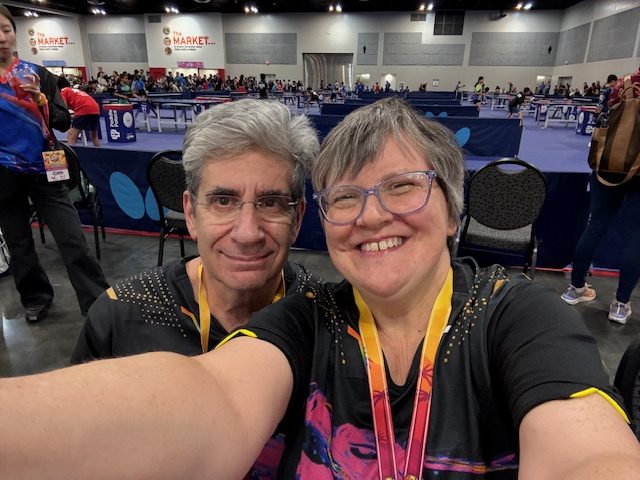
I have heard players say that they don’t feel good enough to play in a tournament as though there is some formula or standard they have to pass. I think that this is an unnecessary barrier. There is no objective test that says once you’ve done “x” now you can compete. I think the biggest barrier is mental.
Hopefully, you’ve been playing different people at your club or recreation center, and maybe you’ve gotten some lessons. Maybe, you are a natural and have great hand-eye coordination. (I’m jealous.) Perhaps, you are beating your opponents easily. Or maybe, you feel you are always losing. (That’s me. You are not alone!)

Table tennis isn’t always about competition. That’s OK. We may say, “let’s just hit, and not play for points.” And that’s OK, and I certainly enjoy the times when I’d rather be social, and hit the ball and chat. But I think to improve your game you need to play as many different people as possible. And that means playing players who are vastly better and more skilled than you. I also think playing in tournaments helps train and finetune the mental aspect of the game. (I’ll explain more about this later.)
I’m too shy to ask a very good player to hit with me. I find that when I compete in tournaments, I’m forced to play many players who I wouldn’t normally play. And that’s a good thing.
That’s one of the reasons why I like tournaments.
Tip: Start local before big competitions.
Many clubs offer monthly tournaments, or weekly leagues. Some tournaments are local like that. Others are at the state level. Or at the National level. Check your local club or recreation center. (Many clubs have email listservs, so make sure you are on those.) For others check Omnipong. Don’t forget for those of you 50+ that there are age related tournaments – like State Senior Games, and Huntsman World Senior Games (multi sport.) And in some of the larger tournaments there are age related events as well.

It’s OK to feel nervous before a tournament. Everyone feels nervous. It’s exciting. It’s terrifying.
Pre- Tournament Suggestions.
Tip: Double check tournament rules. Most tournaments have rules relating to player check in. Also check to make sure your understand the format, and the time committment. Don’t assume.
The tournament director sets up the “draw”. That is, who gets to play who and in what order. The tournament structure sets out how many matches at a minimum you will get to play. For example, perhaps your tournament is a round robin, where you have 6 players in your group, and you get to play all the players (that is 5 matches.) Maybe the tournament is single elimination – which means at a minimum you will play one match. Maybe in your first round, maybe only the top two players in that group advance. Maybe its only the top player. Maybe there is no advancing to a second round. In short, there are different types of tournaments, and structures.
Tip: Pack your bag. Don’t forget your shoes, paddle and water bottle. I recommend you include some energy bars, or your favorite energy drink, or even a protein shake. Pack a backup paddle, if you have one.
Tip: Arrive in plenty of time so that you can get enough time to warm up. Every tournament should provide you with time when competition begins including when tables are open for warm up. For me, Kevin and I have a warm up routine that works for us.
Part of that warm up includes stretching. Don’t forget to stretch. I use moves from Qigong especially moves from Yi jin jing. (I find that Qigong also helps my mental preparation.)
During the Tournament suggestions
Tip: Make sure you know which table or tables you will be playing at. There is nothing worse than not knowing where to go. This will usually either be announced before hand, or it will be posted on the tournament app.
Tip: Always ask your opponent to see their paddle and the paddle’s surface. There is no rule that your opponent has to show their paddle to you. The rule is you can ask. You can always show your paddle, but don’t forget to ask to see theirs. Why does this matter? Because some surfaces, like short or long pips, and anti spin change the spin and play of the game. As a beginner don’t get too in your head about this. Just make notes of how you played against a player with an unusual playing surface.
Tip: Record your matches. When I’ve done this, I’ve found rewatching my play incredibly useful. Also, it’s fun to watch those points or rallies where you nailed it. (It’s very common for players to record their matches, but I always ask my opponent if they mind as a courtesy. Most don’t mind at all. Many want you to sent them a copy of the recording.)
Tip: Calling for a time out. A player can call for one time out of 2 minutes during the match. Calling for a time out is not only for players who have a coach. I often forget to do this.
Tip: Write your score after each game. Don’t forget to do this. I like to have the winner write the score. I always double check with my opponent. And don’t wait to the end of the match. If the scoring is on paper, use your phone to take a photo of the score sheet. (Tournaments are becoming more digital, many now have apps where players enter their scores.)
Tip: Understand the rules of the game. At the very least know how to do a legal serve. Make sure that your toss is the correct height, that the ball is tossed from a flat hand from behind the table (but not underneath) and that your body is not blocking the contact of ball and paddle. If your serve isn’t legal, your opponent will usually tell you in a friendly way. If they feel you haven’t corrected it, their next step is to call the tournament director, umpire or referee (depending on type of tournament.)
Tip: Focus on playing well for you at your skill level, rather than winning. Who doesn’t love winning or lifting that trophy overhead? It’s a wonderful feeling. But don’t be afraid to lose. Maybe I say this because I lose more than I win. (At least, that’s what it feels like.) But competition reveals so much about your game. Weaknesses that you need to work on. Maybe you need to work on your serve, and serve variety. Or maybe your forehand is weak. There’s so much to learn.
Tip: Be kind to yourself. Playing is supposed to be fun. A first tournament (and to be honest, every tournament) is a learning experience. But it’s also an opportunity to make new friends and connect to old ones. It takes courage to show up.
Good luck!